
In this lecture, I want to connect what we have been doing with scientific notation (which I’ll define for you if you haven’t seen it). I also want to give some examples of how logs are used to understand large numbers, make estimates, and do mental calculations.
Scientific Notation
First, let me remind you of exponent notation. The notation  means multiply 10 by itself, x times:


and so forth.
This means that, in the way we were talking about before, the number has x zeroes. Well, we can then extend this. We decided that 3 has roughly half a zero, so we could write  . (And if you recall our discussion about that, the number that has exactly half a zero is the square root of 10:
 exactly.)
When we were calculating logs, we started by rewriting the number in the form of a number between 1 and 10, times a multiple of ten. For example, in finding the log of 63,536, the first step was to write

The name for this way of writing a number is scientific notation. There are many advantages to writing a number this way. The most important part of a number for many purposes is its rough size, that is, how many zeroes it has; writing 63,536 this way, we are saying that it is “4 plus a bit” zeroes.
Finding the log takes this a step further; it encodes the entire number in the number of zeroes. We estimated that  ; checking on a calculator, we find that
 , to four decimal places. So the number 6.3536 contributes 0.8030 zeroes; we could write
 ,
which means
 ;
the number 63,356 is 4.8030 zeroes, to four decimal places.
Scientific notation is a very standard way of writing numbers in technical work. Writing them as their number of zeroes—as their logarithm, or their power of ten— is not so standard. But thinking of them this way is quite standard, and gives some common and useful tricks for understanding and working with large or small numbers.
Problem 1: Write each number (i) in scientific notation, and (ii) approximately as a number of zeroes (that is, power of 10) (do this without a calculator).
a. 585
b. 656 billion
c. 3,500,000
Make up some more numbers to do this with, until you get the hang of it. (This is really no different from computing logarithms of the numbers. I’m phrasing it slightly differently, but it’s the exact same computation.)
Estimations and Fermi Problems
In order to talk intelligently about problems involving large numbers, it is necessary to have some intuition for what is large or small in your particular context. For example, in talking about national or international policy problems, it is common to talk about costs in millions and billions and trillions of dollars. Without a little training, these numbers all sound like “really huge or whatever”. But it is very important to understand what is truly large for a given context, and what just seems large.
Part of this is just experience; people who think about, say, education policy, have a sense of what 10 million dolllars will buy, versus 100 million or a billion. These numbers just seem “big”, but 100 million is ten times 10 million. If you hear a building cost 10 million or 100 million to build, it sounds sort of the same. But if you go to buy a can of soup, and you have a choice between one that costs 2 dollars and one that costs 20 dollars, you know the difference!
Aside from having actual experience buying multi-million dollar things, another way to build intuition is to get in the habit of estimating. Thinking in terms of logarithms and number of zeroes helps with this.
Here’s an example: let’s guess the GDP of the United States. GDP is “gross domestic product”: roughly speaking, it is the value of all the goods and services produced by every person and company in the US per year. It’s not easy to guess off the top of your head, but it’s easy to get an estimate.
Start with the population of the US, a number everyone should know: about 300 million. (Not exactly, but I’m estimating here.) That is 8.5 zeroes ( ). (Right!? Check my math!)
Now, how much does everyone make? What’s the average salary? I’m going to say 30,000 a year. Now, I might be off: maybe it’s 50,000. But I’m just trying to get the number of zeroes right. How many people are actually working? I’m going to guess 200 million. Again, I could be off, but I’m aiming to get the right number of zeroes.
So, we have 8.3 zeroes ( ) number of working people, each making 4.5 zeroes (
 ) dollars each per year. For total dollars made per year, you multiply; but multiplying adds zeroes. So the total income is 8.3 + 4.5 = 12.8 zeroes worth of dollars per year,
 dollars per year.
Now, that was income. But GDP was supposed to be output. Now, people aren’t going to make in income what they produce in output: the corporate parasites capital investors are going to be making profits. That means the GDP will be bigger than income by some factor, which takes into account all the extra money businesses and corporations are making. I’m going to make a rough guess and say this factor is 3; that incomes are about 33% of GDP. So I should multiply my final number by 3, that is, I should multiply by  , that is, I should add 0.5 zeroes.
(I don’t really know this; I’m just guessing. But here’s how I’m guessing. I don’t think total incomes are 100 per cent of GDP: businesses and corporations are making a lot of money. But I do think that personal incomes are a substantial chunk of GDP; I don’t think they are as small as 10 per cent of GDP. So I am picking half way between 10 per cent and 100 per cent; but half way in the multiplicative sense, so I’m guessing about 30 per cent, or one third.)
So in the end, my guess for GDP is 12.8 plus 0.5 zeroes, or 13.3 zeroes; that is to say,  dollars. Now, 12 zeroes is a trillion, and 1.3 zeroes is about 20 (why?), so I get an estimate of
US GDP is about 20 trillion dollars per year.
Wikipedia says:

Ha!
(I didn’t look this up beforehand, honest.)
The counting of zeroes may seem a little foreign at first, but it is a very common practice among scientists who need to regularly work with large numbers. For one thing, it makes huge numbers manageable: for example, the number of atoms in the entire observable universe is something like  or
 , so our brains never have to manage numbers bigger than 80 (and usually smaller ones). For another thing, in problems like this, we are almost always multiplying, which is difficult both for doing mentally and for having an intuition. But number of zeroes (the logarithms of the numbers) add rather than multiply. Adding is easier.
So, this whole process seems a little weird and difficult at first, but it becomes very quick and easy with practice, and is valuable in all kinds of places. Getting in the habit of doing this will give you a facility with and intuition for very large and very small numbers, which can be powerful.
Problem 2: Make an estimate of the total US consumption of oil per year. (Hint: You could start with cars. Guess how many miles each car owner drives, and miles per gallon. Then guess what percentage of oil consumption goes to cars. There are other ways to approach it too, but try to work from things you can reasonably guess. Don’t be too fussy; being off by a factor of 2 or 3 in places is to be expected. We’re just trying to get the number of zeroes right.
Once you have an answer, look up the actual figure, and see how close you got.
This method can also be useful for mentally calculating large numbers, where you could in principle find an exact answer, but all you want is a rough answer.
For an example: most Vermont license plates consist of three letters and three numbers.

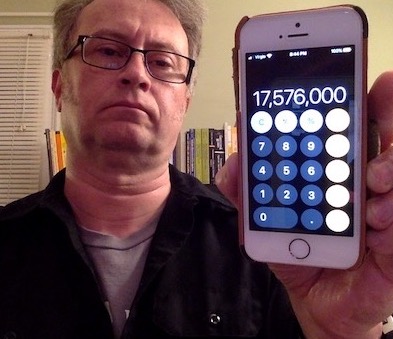
How many license plates are possible in principle? Well, there are roughly 26 choices of the first letter (probably they avoid using letter “O” or “I”, and some vulgar combinations, but I won’t worry about that). For each choice of first letter, there are 26 choices of second letter, so 26 x 26 choices for first two letters. Continuing this way, the number of license plates is
26 x 26 x 26 x 10 x 10 x 10.
Don’t reach for the calculator yet! I want to show you how a scientist does this immediately mentally.
The numbers are easy: each digit gives one decimal digit of information, that is one zero. So the 10 x 10 x 10 gives 1,000 , that’s easy.
How many decimal digits of information are contained in a letter? That is, how many zeroes is 26? Using our methods, you should see that log(26) is about 1.4 or so. So each letter contributes 1.4 zeroes. (More formally,  .)
The letters give 1.4 + 1.4 + 1.4 = 4.2 zeroes, and the numbers give 3 zeroes, so we get 7.2 zeroes total. Then, 7.2 zeroes is roughly
17 million different license plates possible.
(Right? How did I convert 7.2 zeroes back into a number?)
Let’s check by putting 26 x 26 x 26 x 10 x 10 x 10 in a calculator:
Problem 3:
a. Calculate the approximate number of seconds in one year, using this logarithm method. Don’t use a calculator. Once you get your answer, though, check it on a calculator.
b. How many seconds old is the universe? (The universe is about 13.8 billion years old, according to current theories and measurements.)
